Tulip mania — the first speculative bubble in history
In 17th-century Holland, a tulip bulb came to cost as much as a house. Then it all collapsed in a single day. The oldest lesson about greed and crazy prices.
In the winter of 1636, a story circulated more and more often in the towns of the Dutch Republic: tulip bulbs trading for sums equal to the price of a canal house. This was the era history nicknamed tulip mania — often called the first speculative bubble in history. But the truth is subtler than the legend. Behind the image of an entire nation gone mad for flowers lies a more accurate and more useful lesson about how inflated prices are born and how they die. Let us separate it from the myth, step by step.
Where the tulips came from
The tulip is not Dutch in origin. It reached Europe from the Ottoman Empire: in 1554, the ambassador Ogier de Busbecq sent bulbs from Constantinople to Vienna, and the botanist Carolus Clusius cultivated them at the University of Leiden's garden around 1593. The Netherlands' sandy soil and climate suited it perfectly, and the flower quickly became a passion. For a wealthy merchant in Amsterdam or Haarlem, a rare bulb was not merely a plant but a sign of taste, of knowledge, and of social standing.
All this took place at the height of the Dutch Golden Age, when the Republic was one of the richest and most commercial societies in the world. There was money, there was a merchant class eager to display its success, and there was a sophisticated market accustomed to shares, insurance, and contracts. Against this backdrop, the passion for a beautiful flower could turn, for a while, into a market for speculation.
The "broken" tulips and a hidden virus
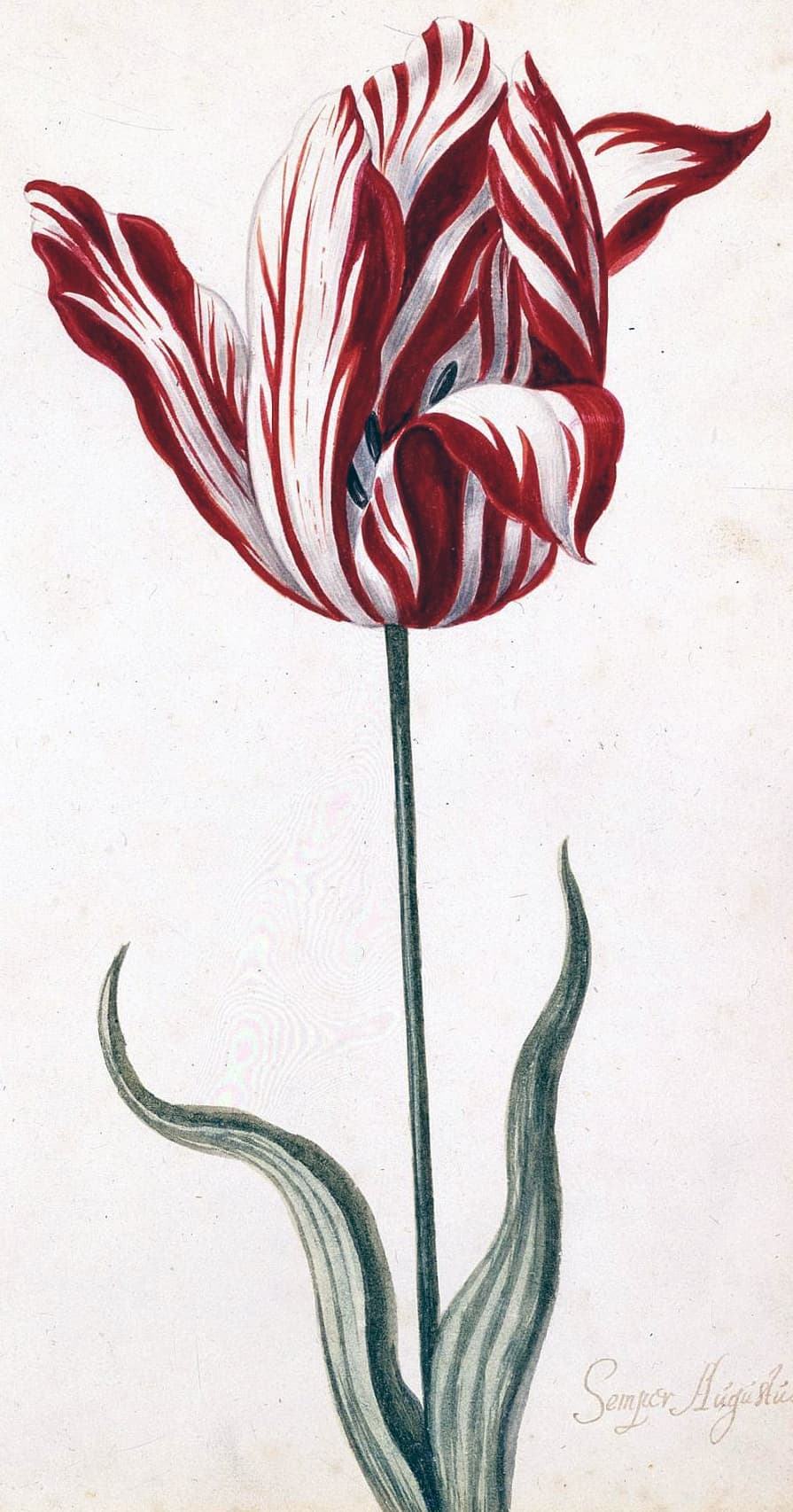
The most coveted tulips were the "broken" ones — petals streaked with stripes and flames of color in spectacular, unpredictable patterns. The mystery was only solved centuries later: the effect was caused by a mosaic virus (tulip breaking virus) that "broke" the uniform color into unique designs. The cruel irony was that the same virus weakened the bulb and reduced its propagation, so the most beautiful varieties were also the rarest and hardest to reproduce. Scarcity, which no one could control, fed the price directly.
At the top of this hierarchy stood the Semper Augustus, a tulip with red petals on a white ground, considered the most beautiful and most expensive of all. A single bulb is said to have been valued at around 10,000 guilders — an enormous sum, comparable to the price of a grand house on the Amsterdam canals, or more than ten times the annual income of a skilled artisan. The bulb eventually vanished from history, probably because of the very virus that made it so spectacular.
The wind trade
Here comes the truly modern part. Bulbs can only be lifted from the ground in summer, during their dormant phase. In winter, while the plant was still in the soil, traders no longer sold the physical bulb but a written promise to deliver it in summer. In effect, they traded forward contracts — the direct ancestors of today's futures. The Dutch called this windhandel, the "wind trade," because no one saw or touched the goods: only the paper was bought and sold.
Trades happened not at an exchange but in taverns, in informal groups called "colleges." There were rituals, entry fees, and a small commission paid "for wine." A single contract could pass through several hands in one winter without a single bulb leaving the ground. Each buyer paid more than the last, convinced he would find someone else to pay even more. This is the mechanics of a speculative bubble: the price no longer reflects usefulness, only the expectation that a more enthusiastic buyer will appear tomorrow.
The winter of 1636–1637 and the crash
Prices peaked in the winter of 1636–1637, after months of dizzying gains. Then, in February 1637, everything stopped abruptly. A contemporary account places the moment at an auction in Haarlem, where a seller could not find a single buyer no matter how far he cut the price. The news spread quickly, and confidence evaporated within days. Contract prices collapsed dramatically — in some cases by more than 90%. The chain of promises broke: no one wanted to buy a piece of paper that everyone now knew was no longer worth what it claimed.
A legal tangle followed to match. Buyers refused to pay for bulbs worth almost nothing, while sellers demanded the money they had been promised. The authorities intervened late and reluctantly; in the end, many contracts were cancelled or settled for a fraction of their value — in some cases with a small penalty, as a kind of compromise. For most people, the real loss was far smaller than it sounded on paper, because that money had never actually been paid.
What was myth and what was real
Here is the part textbooks often leave out. Much of the dramatic legend comes from an 1841 book by the Scotsman Charles Mackay, Extraordinary Popular Delusions and the Madness of Crowds, full of colorful anecdotes — such as the story of a sailor who supposedly ate a precious bulb by mistake, thinking it an onion. Mackay described an entire society ruined, from nobles to weavers. Modern research, however, tells a different story.
The historian Anne Goldgar, in her book Tulipmania (2007), spent years in the Dutch archives and found something surprising: fewer than 400 people were actually involved, almost all of them well-off merchants, artisans, and professionals — not the poor, not weavers selling their looms. She found no evidence of mass ruin, bankruptcies, or suicides caused by tulips. Many of the horror stories in fact came from moralizing pamphlets of the time, written by critics who wanted to condemn greed and speculation as sin, not to report facts. Goldgar does not claim the bubble never existed — prices truly did rise and fall sharply — but that the economic damage to the Republic was far smaller than the legend claims. The real harm was rather one of trust and honor, in a society where a person's given word mattered enormously.
The exaggerated figures of tulip mania were passed down as a moral warning, not an accurate account — and the warning survived precisely because it sounded spectacular.
Why the story still matters today
Even stripped of its exaggerations, tulip mania remains a living textbook of market psychology. It had all the ingredients we see again in every bubble since: an asset hard to value correctly, real or imagined scarcity, contracts that allow speculation without the goods, a wave of self-feeding enthusiasm, and a sudden crash the moment confidence disappears. That is why the phrase "tulip mania" became a universal metaphor for any speculative madness.
It has been invoked at the dot-com bubble of the late 1990s, at the housing-credit crisis of 2007–2008, and repeatedly in connection with cryptocurrencies — a governor of the Dutch central bank even called Bitcoin "worse than tulip mania." The comparisons are sometimes unfair and overblown, exactly like the original legend. But the underlying question always stays the same, and it is worth asking of any price that climbs steeply: am I buying this for what it is, or only because I hope someone else will pay more tomorrow?
The lesson, without the real risk
The best way to understand a bubble is to feel for yourself how prices are born, how enthusiasm spreads, and how fast confidence evaporates — without risking a lifetime's savings. That is exactly why the Kosron ecosystem was built: a place where you can learn the mechanics of money, transfers, and speculation in a safe environment. KOSR has no real value and cannot be turned into real money; it is an educational currency, a playground for the mind. So you can make the kind of "mistakes" that teach a great deal — spotting a price that rises irrationally, recognizing the moment when everyone buys only to sell higher — without a tulip ever costing you as much as a house.