Koson — the gold of the Dacians and the coin that inspired KOSR
The first gold coin minted on the territory of present-day Romania. The story of the Koson stater, the ΚΟΣΩΝ inscription and the eagle watching over its reverse.
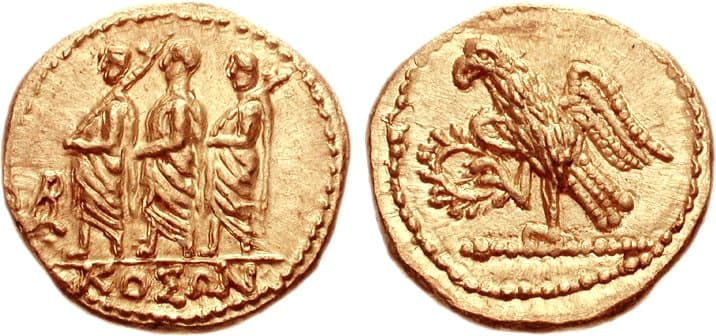
More than two thousand years ago, in the 1st century BC, craftsmen in the heart of Dacia struck gold coins that would enter history under the name Koson (ΚΟΣΩΝ). These are solid gold staters, weighing roughly 8.4 grams with a diameter of 18–21 mm, regarded as the oldest gold coins issued on the territory of present-day Romania. Their beauty, purity and mystery have stirred the curiosity of numismatists and the greed of treasure hunters alike, for centuries on end.
What exactly is a Koson stater?
The word stater comes from the Greek world, where it denoted a standard coin of gold or silver. The Koson stater is a Geto-Dacian gold coin, dated by most scholars to around 44–42 BC, during the turbulent years of the Roman civil wars. The dating rests on a hypothesis formulated in the 19th century by the historian Theodor Mommsen, who placed the minting between the Ides of March 44 BC (the assassination of Caesar) and the Battle of Philippi in 42 BC. Other specialists argue for a slightly later issue, but the consensus holds: this is a coin of the 1st century BC.
Unlike the so-called "pseudo-Lysimachus" gold coins that circulated in the Carpathian-Danubian region at the same time (imitations of the staters of King Lysimachus of Thrace), the Koson carries a completely different iconography, borrowed straight from the Roman world. It is precisely this blend of symbols — Greek, Roman and local — that makes it so fascinating.
The three figures and the ΚΟΣΩΝ inscription
On one face — described by most catalogues as the obverse — three toga-clad figures advance in procession to the left: a Roman magistrate accompanied by two lictors carrying fasces over their shoulders, the bundles of rods that symbolized public authority in Rome. Beneath their feet, in Greek letters, stands the name of the coin: ΚΟΣΩΝ. In the left field there sometimes appears a small monogram, usually read as BR.
The scene is not a Dacian invention. It copies almost faithfully a silver denarius issued in 54 BC by Marcus Junius Brutus — the same Brutus who, ten years later, would lead the conspiracy against Julius Caesar. On that denarius, Brutus depicted his ancestor, the consul Lucius Junius Brutus, walking between lictors. The fact that a coin struck in Dacia reuses a Roman image so charged with political meaning says a great deal about the ties between the Geto-Dacian world and the Rome of the late Republic.
The eagle on the other face
On the opposite face perches an eagle with partly spread wings, standing on a scepter and clutching a laurel wreath in its talons. This motif, too, has a Roman source: it echoes the denarii issued by the moneyer Quintus Pomponius Rufus. The eagle with wreath and scepter was a classic emblem of power and victory — exactly the kind of image a Dacian ruler would have wanted on his own gold coin.
It must be said honestly that numismatists do not fully agree on which face is the obverse and which the reverse: some modern catalogues (including Wikipedia-style descriptions) treat the eagle as the obverse and the procession as the reverse; others do exactly the opposite. Whatever the convention, the eagle has remained the most recognizable symbol of the coin — and it is the one we carried, respectfully, into the Kosron Bank crest.
A good coin tells a story from both sides: on one face, people walking; on the other, an eagle keeping watch.
The BR enigma: was Brutus behind the gold?
The little BR monogram has given rise to one of the most debated theories in Romanian numismatics. The key word is Brutus. After Caesar's assassination, Brutus gathered troops in the Balkans and, according to the sources, made use of Thraco-Dacian mercenaries. One hypothesis holds that the Roman gold he brought with him was turned into Koson staters to pay these troops — hence the BR monogram.
Metallurgical analysis brings a surprising argument to this debate. Two categories of Kosons have been identified: those with the BR monogram, struck from very pure gold with no traces of tin, and those without the monogram, made from native alluvial gold containing traces of tin — exactly the same composition as the famous Dacian gold bracelets. In other words, the monogram-free specimens appear to have been struck locally, from Transylvanian gold, while the BR pieces may reflect the involvement of Roman gold. A word of caution, though: this remains a plausible hypothesis, not a proven certainty.
Who was Koson?
The name written on the coin — ΚΟΣΩΝ — is, in the view of most scholars, the name of a local Geto-Dacian or Thracian king, otherwise unattested in the written sources. The most popular hypothesis links it to Cotiso (or Cotison), a Dacian king mentioned by the poet Horace and by Suetonius, active in the time of Augustus. The closeness of the names is tempting, but there is no firm proof that the two are one and the same person.
It is also remarkable that a coin struck in Dacia bears a legend in Greek, not in Latin. Greek was the language of trade and prestige across the entire Balkan and Pontic world, and its use shows just how connected the Dacian lands were to the great cultural networks of antiquity.
The treasures of the Orăștie Mountains
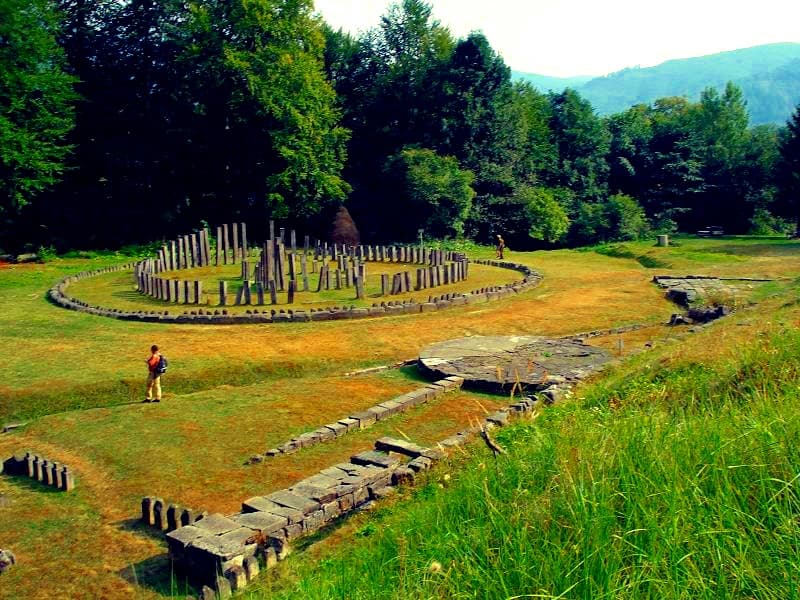
Koson staters were not found scattered one by one, but in hoards of thousands of pieces, hidden in the soil of Transylvania. The most important came to light in the area of Sarmizegetusa Regia, the religious and political capital of the Dacians, in the Orăștie Mountains. Sadly, many of these treasures were not unearthed by archaeologists but by looters with metal detectors, in the years after 1990.
Between roughly 1996 and 2001, organized gangs dug illegally at several points around Sarmizegetusa, bringing to light thousands of Koson and pseudo-Lysimachus staters, alongside the spectacular spiral gold bracelets. A large share of these pieces were sold clandestinely abroad. Through long international proceedings, the Romanian state managed to repatriate more than 13 gold bracelets and several kilograms of coins — today on display at the National Museum of Romanian History in Bucharest. Many others remain, perhaps forever, lost.
What is a Koson worth today?
On international numismatic markets, an authentic Koson stater usually sells from a few hundred to a few thousand euros, depending on condition, type (with or without monogram) and, above all, a legal, documented provenance. Exceptional specimens in near-perfect condition can exceed that range. In 2005, the National Bank of Romania even issued an official collector's replica, struck in 99.9% gold.
And yet the true value of a Koson does not lie in its grams of gold. It lies in the story it carries: about the Dacians and about Rome, about Brutus and about a king whose name we barely still know, about a land where its own coin was struck two millennia ago. It is a silent lesson in financial history, one you can hold in the palm of your hand.
A coin is a story you can hold in your palm. KOSR is our educational tribute to that story.
That is exactly where we started when we created KOSR: an educational coin inspired by the Koson, designed to help you understand how money works and how value travels through time. Unlike the gold of the Dacians, KOSR has no real value and cannot be exchanged for real money. It is simply a learning tool — an eagle keeping watch not over a treasure, but over your curiosity.