When a loaf of bread cost a billion — German hyperinflation
In 1923 Germany, people carried money in wheelbarrows and burned banknotes in the stove. History's most famous lesson on what happens when you print money without limit.
In the autumn of 1923, a German who wanted to buy a loaf of bread no longer fished a few coins out of his pocket — he wheeled stacks of banknotes in a wheelbarrow, paid billions of marks, and hurried, because the price might rise again before noon. The hyperinflation of the Weimar Republic was not a simple bout of rising prices but a total collapse of trust in a currency. To this day it remains history's most quoted example of what happens when a state prints money without limit. Its story is not one of greed but of a chain of political and military decisions that turned, month after month, into an economic disaster of almost unimaginable scale.
The roots: a war financed on credit
The seed of the crisis was planted long before 1923. When the First World War broke out in 1914, Germany abandoned the convertibility of the mark into gold and chose to finance the war almost entirely through borrowing and money printing rather than through taxes. Its leaders gambled on a quick victory, after which the defeated would foot the bill. Victory never came. By the end of the war the mark had already lost nearly half its value, and the state was left with a mountain of domestic debt and an exhausted economy.
Onto this fragility came, in 1919, the Treaty of Versailles. In 1921 the Reparations Commission fixed the sum Germany owed the victors at 132 billion gold marks — an enormous burden, denominated in a gold-linked currency, that a near-bankrupt state was meant to pay in hard currency and goods. Rather than balance the budget through unpopular taxes, the governments in Berlin kept covering both ordinary spending and reparations by setting the printing presses in motion. The mark began to slide, slowly at first and then ever faster.
The spark: the occupation of the Ruhr in 1923
The turning point came on 11 January 1923. Accusing Germany of falling behind on the coal and coke deliveries required as reparations, French and Belgian troops occupied the Ruhr, the country's industrial heartland. The government of Chancellor Wilhelm Cuno responded with a policy of passive resistance: workers in the region were urged to strike and refuse all cooperation with the occupiers, while the state pledged to pay their wages for as long as they stayed home.
It was a patriotic decision, but a ruinous one. Germany's industrial heartland had ground to a halt, so tax revenue collapsed at precisely the moment the state had to pay millions of people who were producing nothing. The only remaining source of money was the printing press. The Reichsbank flooded the economy with banknotes to cover wages and subsidies, and the already weakened mark went into free fall. What had been severe inflation became, within a few months, hyperinflation — defined by economists as price increases of more than 50 percent per month.
The numbers of a madness
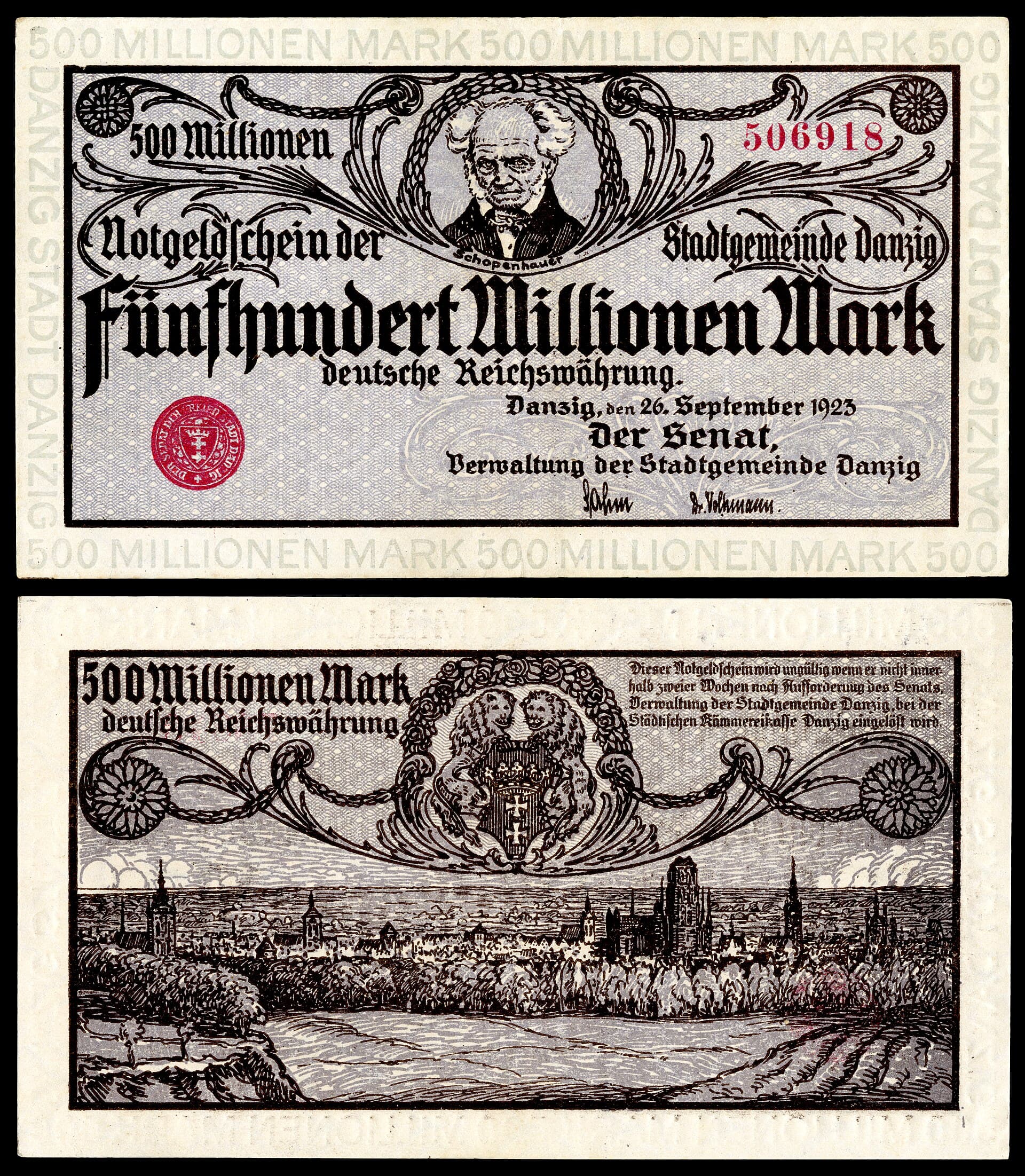
The scale of the disaster defies intuition. Before the war, one U.S. dollar was worth about 4.2 marks. By the end of 1922 the rate had reached several thousand marks to the dollar. Then, in 1923, everything exploded: by November a single dollar was worth roughly 4,200,000,000,000 — that is, 4.2 trillion marks. The central bank could no longer even print fast enough; banknotes were given ever larger figures, and the largest note ever issued bore the face value of 100 trillion (100,000,000,000,000) marks.
Everyday prices tell the same story. A loaf of bread that cost around 160 marks at the end of 1922 cost roughly 200 billion marks by late 1923. Accounts from the period describe a student who ordered a cup of coffee priced at 5,000 marks and, by the time he had finished it, the posted price had jumped to 7,000. Wage earners were paid twice a day and rushed to spend their money at once, because within a few hours the same notes would buy far less.
Money carried in wheelbarrows
From this period come the images that travelled the world: people pushing wheelbarrows or laundry baskets of banknotes to buy food, housewives lighting their stoves with piles of marks because the paper burned more cheaply than the wood it could have bought, children pasting banknotes on walls as wallpaper or building towers out of bundled cash. Money had lost the very function of being money.
Beyond the picturesque images, the tragedy ran deep. Those who lived on fixed salaries, pensions or bank savings were ruined: a lifetime of thrift evaporated in a matter of weeks. The middle class, the backbone of any stable society, was wiped out. The winners, by contrast, were debtors — including the state, which erased its domestic debt by paying it off in worthless marks — and those who held real assets: land, factories, gold, foreign currency. Inequality and resentment rose along with the prices.
Inflation is as violent as a mugger, as frightening as an armed robber and as deadly as a hit man.
The end: the birth of the Rentenmark
The madness stopped almost as abruptly as it had begun — through political will. In August 1923 Gustav Stresemann became chancellor and took the hard decisions no one had dared to make: on 26 September he ended passive resistance in the Ruhr, cutting off the spending that fed the printing press. On 15 November 1923 a new currency, the Rentenmark, was introduced, backed not by gold, which the state did not have, but by a mortgage on all of Germany's industrial and agricultural land. The exchange rate was fixed at one Rentenmark to one trillion old marks — and, symbolically, at 4.2 Rentenmark to the dollar, exactly the pre-war rate.
What proved decisive was that the new currency was issued in strictly limited quantity. The Reichsbank, now run by currency commissioner Hjalmar Schacht — appointed on 12 November and installed as president after the death of Rudolf Havenstein on 20 November — refused to keep financing the deficit through printing. Finance Minister Hans Luther imposed severe budgetary austerity. Because people once again believed money would hold its value, confidence returned almost overnight. In August 1924, under the Dawes Plan, which restructured reparations with the help of American loans, the Rentenmark was supplemented by the Reichsmark, a currency once again tied to gold.
The political scar
Stabilization saved the economy, but the trauma remained. At the very peak of the crisis, on 8–9 November 1923 in Munich, an agitator named Adolf Hitler attempted a coup — the famous Beer Hall Putsch. It failed and landed him in prison, but the anger and insecurity fed by hyperinflation did not disappear. An entire generation that had watched its savings turn to dust lost its faith in democratic institutions. Many historians believe this wound prepared the ground, a decade later, for the rise of the Nazis. The worthless banknote thus became not only an economic lesson but a political one.
It is precisely for this reason that the Weimar hyperinflation remains the obsession of modern central banks, especially the German one. It demonstrated, in the most extreme form, a simple truth: trust in a currency is built slowly, over years, and can be destroyed in a few months if the quantity of money slips out of control.
The eternal lesson and the link to Kosron
The story of the Weimar Republic distills the very lesson Kosron teaches: limitless printing destroys the value of money. A unit of money is worth something only as long as it stays scarce and people trust it will keep some of its purchasing power. When the quantity explodes, value evaporates — no matter how many zeros you write on the paper. That is why KOSR has a fixed, predetermined supply that cannot be inflated endlessly by a virtual printing press.
An important caveat: KOSR is a purely educational instrument, with no real value and not a means of investment. It will not make you rich and must not be treated as real money. Its role is to let you feel, on your own skin but without risk, the mechanisms that millions of people learned in 1923 at the cost of their lifetime savings: that scarcity is not a whim but the very condition of value.