The Roman denarius — the coin that held an empire together
For nearly 500 years, one silver coin paid legions, roads and bread. The story of the denarius — and history's first great lesson in inflation.
Few objects have held so vast a world together so quietly. Introduced around 211 BC, in the thick of the Second Punic War, the small silver disc called the denarius came to pay legions from Britannia to the Euphrates, to buy grain in Egypt and oil in Hispania, to fix prices across a market that spanned three continents. For almost five centuries it was the reference coin of the Mediterranean world. And its slow collapse remains, to this day, one of the clearest economics lessons Antiquity ever left us: what happens when a state needs more money than it can honestly produce.
How the denarius was born
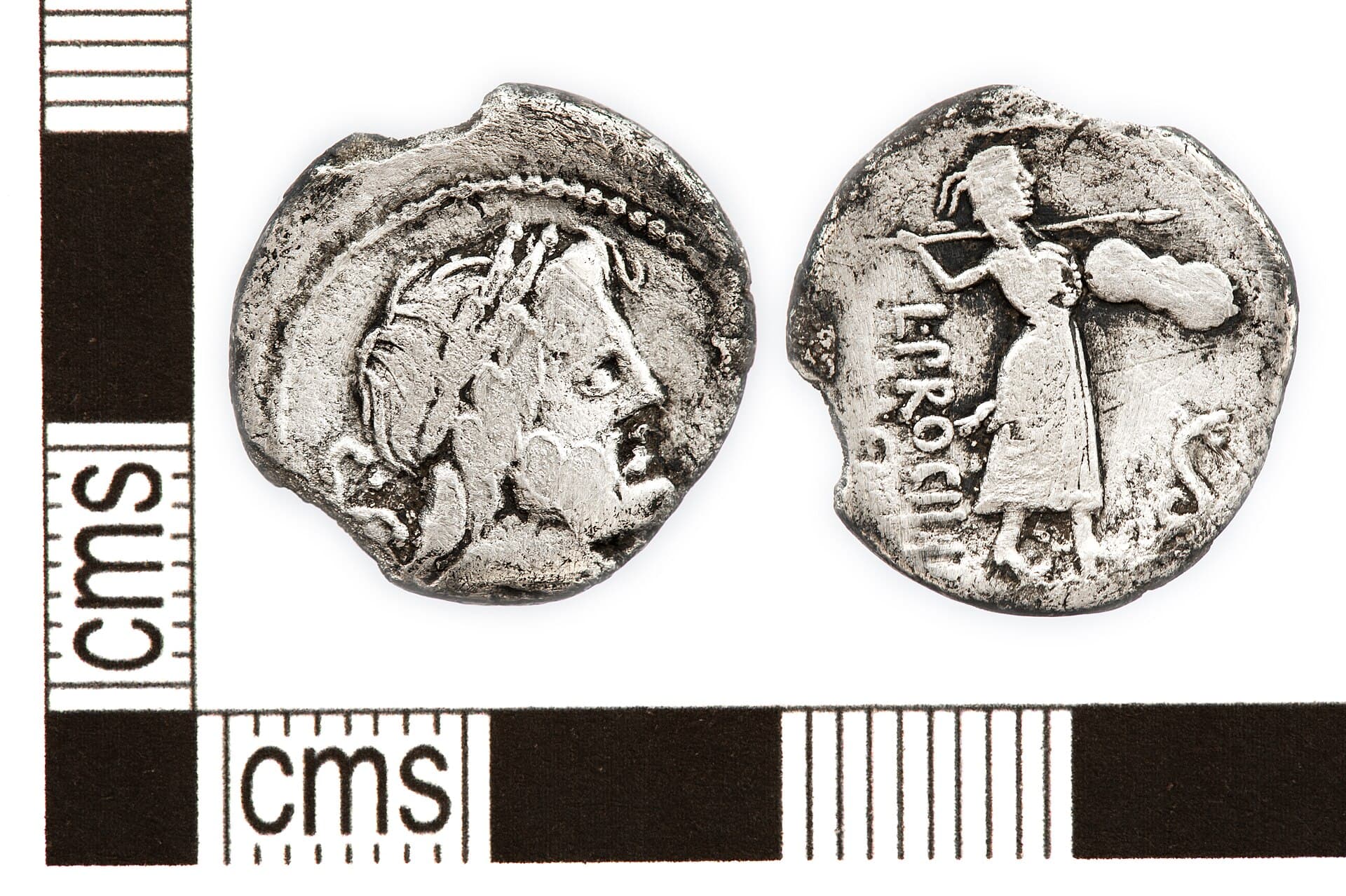
Before the denarius, Rome made do with a cumbersome bronze system and imitations of Greek coinage. The war against Carthage drained the treasury and forced a reform. So, around 211 BC, a new silver coin appeared: the denarius. The name comes from the Latin dēnī, "by tens", because at first it was worth ten bronze asses — quite literally, "the tenner". It was struck from nearly pure silver and weighed on average about 4.5 grams, that is one seventy-second of a Roman pound.
Around 141 BC, as the bronze pieces shrank, the denarius was re-tariffed at sixteen asses. The system then settled around another reckoning coin, the sestertius: one denarius equalled four sesterces. These equivalences look dry, but they were the backbone of an enormous economy — much as the rates between the euro, the dollar and the leu are today.
What a denarius was worth
The most concrete benchmark is a soldier's pay. During the Republic, a legionary earned around 112 denarii a year — under a quarter of a denarius a day, from which food and equipment were deducted. Julius Caesar doubled the pay to roughly 225 denarii a year, and later the emperor Domitian raised it to about 300. For an unskilled labourer, a denarius was roughly a day's wage, and with it you could buy bread for several days.
That is why the denarius was not merely money, but also a tool of power. An army paid on time, in good silver, stayed loyal. An army paid in thin coin began to grumble. Many of Rome's political crises spring from this simple equation: whoever pays the legions rules the empire.
Koson gold and Rome
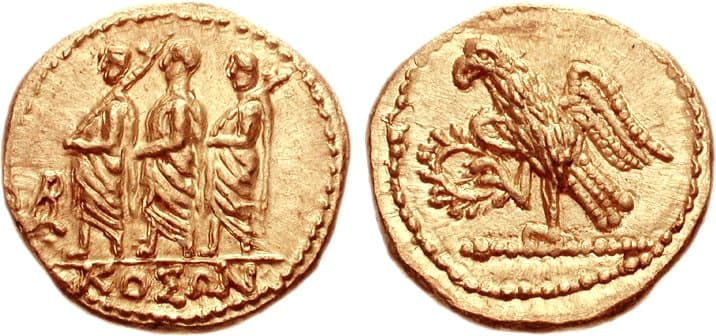
For the Carpathian-Danubian region, the denarius has a surprising visual link. On the reverse of the Koson gold stater, struck in the Geto-Dacian world around 44–42 BC, three toga-clad figures advance — a Roman magistrate flanked by lictors carrying the fasces on their shoulders. The image is copied almost exactly from a denarius of Brutus, issued at Rome in 54 BC by the moneyer Marcus Junius Brutus. In other words, the Dacian gold coin and the Roman silver denarius are visual relatives.
How deep the connection ran is still debated. A widely held hypothesis says the Koson staters were struck in gold to pay Dacian mercenaries fighting for Brutus's "Liberators" in the civil war after Caesar's murder. Other scholars prefer caution and see only a local coin inspired by Roman models. The honest thing to say is that the resemblance is certain, while its interpretation is still discussed — yet even so, it shows how tightly the ancient economies of Dacia were interwoven with Rome.
The slow dilution
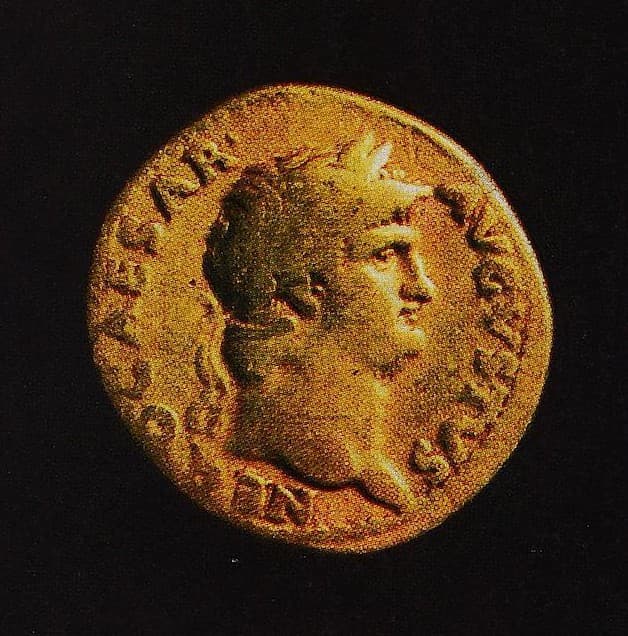
At first, the denarius was almost pure silver. But every emperor needed more money than he had silver — for armies, for building works, for buying peace. The solution was tempting and seemingly harmless: strike the same coin, but with a little less silver in it. Under Augustus, the denarius had already dropped to about 3.9 grams. In AD 64, the emperor Nero took the decisive step: he cut the weight to roughly 3.4 grams and the fineness to about 93.5%. The change looked minor, but it opened a door that never closed again.
This is, in the reading of many historians, the first systematic debasement of a state currency in history. Not a sudden catastrophe, but an erosion. Each succeeding emperor shaved off a little more, convinced no one would notice. The logic was diabolically simple: with the same silver you struck more coins, so you seemed to have more money. In reality, each coin was worth less and less.
The collapse and the antoninianus
In the 1st century AD, the denarius was still over 90% silver. By around 200 it had fallen below 60%. Under Caracalla it stood at roughly 40%, and by about 300 it held, by some analyses, only around 5% silver — the rest cheap metal under a thin silver wash that rubbed off at a touch. In AD 215, Caracalla introduced a new coin, the antoninianus (the "radiate" piece, showing the emperor with a crown of rays). It was declared equal to two denarii, yet contained the silver of only about 1.6 denarii. In other words, the state asked people to accept less silver for the same nominal price.
The result was predictable: prices exploded. Merchants demanded ever more coins for the same goods, because they no longer trusted the metal in them. People began to hoard the old, good coins and pass on only the thin ones — a phenomenon economists would much later call "Gresham's law": bad money drives out good. The monetary crisis intertwined with the political and military crisis of the 3rd century, one of the hardest periods in Rome's history.
The legacy of a word
Toward the end of the 3rd century, Diocletian's reform (around AD 294) tried to restore order, but the old silver denarius had effectively ceased to be struck. Its name, however, survived as a mere unit of account — and then travelled farther than any coin. From dēnārius come "denaro" in Italian, "dinero" in Spanish, "dinheiro" in Portuguese, "denar" in Slovene. The old "d." for the penny in pre-decimal England comes from it too. And above all, from it comes the dinar — the name of the national currency in dozens of countries, from Serbia to Jordan, Kuwait or Algeria.
So although the denarius vanished as metal long ago, it lives on in the vocabulary of millions of people who never suspect they are uttering a Latin word two thousand years old. Few coins have died so slowly and cast so long a shadow.
A coin is worth what people believe it is worth. When trust thins, so does the coin.
What the denarius teaches us today
The denarius's lesson is not about silver, but about trust. A currency works as long as people believe it holds its value. The moment a state begins to quietly "dilute", to cover spending it cannot afford, the price is paid later — but it is always paid, through inflation and through distrust. Rome learned this the hard way, over three centuries.
That is exactly why we love telling these stories at Kosron. Our educational coin, KOSR, has no real value and cannot be bought with real money — it is a learning tool, a kind of "play bank" where you can understand, risk-free, what a currency is, what backing means, and why trust is the most precious metal of all. The Roman denarius was history's first great lesson. KOSR only wants to repeat it, without ever costing anyone a thing.